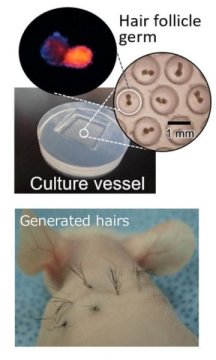
I have covered hair regeneration research by Yokohama National University (Japan) based scientist Dr. Junji Fukuda a few times in the past. His team’s most important work relates to hair multiplication via the production of hair follicle germs.
However, Dr. Fukuda achieved global notoriety in 2018 due to the French Fries chemical related hair loss “cure”. In recent years, the Yokohama Team has published numerous papers. Moreover, they plan to begin hair multiplication trials in humans in 2023.
I first wrote this post in 2021, and will update it regularly. This is due to the importance that I attach to Dr. Fukuda’s groundbreaking work. Make sure to also check Fukuda Lab for the latest news. They seem to publish a new study every few months. Also see the hair section of their website.
April 12, 2023
Yokohama Researcher Junji Fukuda’s New Interview
A detailed new interview with Dr. Junji Fukuda (h/t “Ben”). Nothing in there about their human trial plans for 2023, but nevertheless very interesting.
They are pursuing three different mechanisms for hair regeneration:
- Reactivating the hair follicle tissue that remains in the scalp via transplant special cells. These cells give instructions on reactivation of dormant hairs as well as increasing the thickness of existing hair. For this method, they are working together with Rohto Pharmaceutical. Note that he expects human clinical trials for this method to begin “within the next few years”.
- Inject (transplant) cell tissue prepared in vitro into the scalp and induce new hair follicle tissue to grow. This is based on their successful 2018 results related to “hair follicle primordia” that I discussed in the earlier hair follicle germs link.
- Create and transplant hair follicle tissue containing hair from cells through culture. Based on their 2022 work in relation to “hair follicle organoid”. I discussed this in this very post in the prior updates further below.
In is interesting how much the students are involved in this research. Dr. Fukuda even gives credit to the last method above to one his student’s discoveries. Something that almost never seems to happen in the western world. Even the new company Trichoseeds is part owned by his student lab researchers:
“I founded a venture company together with the students in my laboratory so that the technology could be used for the practical application of hair regenerative medicine. I started the project because I thought that students would be more motivated if they were doing research for social implementation, so they would be able to benefit from it as well.”
October 21, 2022
The un-finalized paper that I mentioned in my prior June update was just released today. Lots of media coverage.
In yet another breakthrough, the Yokahama University team led by Junji Fukuda and Tatsuto Kageyama have managed to grow mature mice hair follicles in cultures. Actual paper here and was published today. The news is already being covered widely in a number of publications, including US News and Yahoo.
According to Newscientist:
Mature hair follicles have been grown in a laboratory for the first time, in a move that could one day treat hair loss.
The hair follicles grew for up to one month, reaching 3 millimetres length. According to Dr. Fukuda, this is probably due to the fact that the mice hair cycle is about one month. Quote from the good doctor:
Our next step is to use cells from human origin, and apply for drug development and regenerative medicine.
Also note that the same team released a new paper on October 1 titled: “Impacts of manipulating cell sorting on in vitro hair follicle regeneration.”
June 25, 2022
The updates from Dr. Fukuda and his team at Yokohama National University (YNU) keep coming and I am excited. Thanks to “Ben” for the links to the two latest papers. Also make sure to see Dr. Fukuda’s patents page.
Junji Fukuda and TrichoSeeds
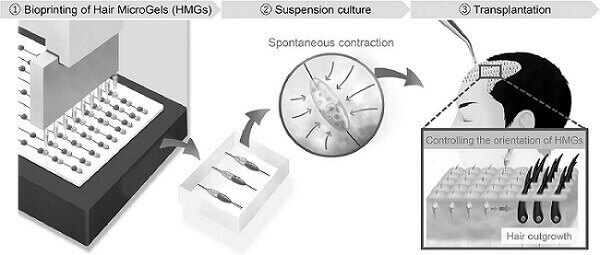
- On June 16, the Fukuda Lab published a new paper titled: “Bioprinting of hair follicle germs for hair regenerative medicine.” This study outlines an approach for the scalable and automated preparation of highly hair-inductive grafts using a bioprinter (image above). The study link also includes two interesting videos at the bottom.
However, perhaps of most interest to me, they declare in the paper that:
“Ayaka Nanmo, Tatsuto Kageyama and Junji Fukuda are co-founders of TrichoSeeds, a company that provides hair regeneration medicine.”
This confirms the original YNU announcement about TrichoSeeds from earlier this year that a number of readers discussed.
- Also published in June 2022 (but not yet peer-reviewed), the Fukuda and Kageyama team authored a paper titled: “Reprogramming of three-dimensional microenvironments for in vitro hair follicle induction.”
While doing research for this update, I discovered the below new April 2022 video published by Yokohama National University in regards to Dr. Fukuda. This all looks to be the real deal….although I said the same in the past about the Dr. Tsuji/Riken team. Also see this earlier 2017 video presentation from Dr. Fukuda.
Update: April 15, 2022
Yokohama University and Dr. Junji Fukuda
- In April 2022, Dr. Fukuda and his team published a paper titled “Effects of the PI3K/Akt signaling pathway on the hair inductivity of human dermal papilla cells in hair beads.”
- In March 2022, the Yokohama team published an interesting new paper titled “Electrical stimulation to human dermal papilla cells for hair regenerative medicine.” I added it to my post on electricity and hair growth.
- Thanks to “Ben” for noticing that Yokohama University’s US patent application for its method for producing hair follicle germs got updated on February 10, 2022.
I consider Dr. Fukuda and his team to be among the five most important players in the world that are working on a hair loss cure. Per last year’s news (see further below), the Yokohama team plans to start human clinical trials in 2023.
In this latest research, the team managed to make new hair that was at first only growing underneath the skin of mice to sprout through the skin. They did this via the use of guide-inserted hair microgels (HMGs). They conclude:
“This approach is a promising strategy to advance hair regenerative medicine.”
Update: April 7, 2021
Interview with Dr. Tatsuto Kageyama
Yesterday, in our Discord chat, “DrPhil” posted a link to a new April interview with Dr. Tatsuto Kageyama of Yokohama National University. It is worth a full read.
After some quick research, I realized that Dr. Kageyama is a co-author in Dr. Fukuda’s important 2019 paper titled: “Preparation of hair beads and hair follicle germs for regenerative medicine.”
This latest interview with Dr. Kageyama is extremely insightful and encouraging.
Human Trials to Start in 2023
The most important news is that human trials will start in 2023. Moreover, the treatment will not be too costly, and it will be safe.
Some key quotes after translation:
“We started basic research using human cells in 2018, aiming to start clinical trials in 2023. And we are working hard together with the members of the laboratory so that we can deliver it to everyone as soon as possible.”
“We also believe that we will be able to resolve cost issues.”
Apparently, they are convinced that the cost of this treatment will be much lower in comparison to other regenerative medicine treatments. A nice change from Dr. Tsuji’s expensive hair loss cure.
The team’s mass culture technology does not necessitate expensive equipment. Moreover, the required amount of hair follicle primordia can be produced with a single culture container.
Hair Follicle Primordium Creation
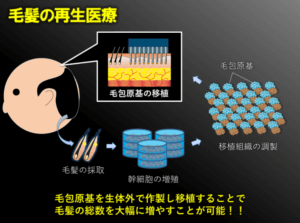
The Yokohama National University team’s hair multiplication process involves creating hair follicle primordia. Epithelial cells and mesenchymal cells mix to form a tissue called “hair follicle primordium“. This is essentially the seed for hair growth.
The process this team uses entails:
- Extract a few healthy scalp hairs.
- Increase the “epithelial cells” and “mesenchymal cells” that exist in those follicles.
- Thereafter, cultivate a large amount of hair follicle primordia.
- Transplant these new cells to balding regions of the donor’s scalp to regenerate the hair.
It will be possible to produce thousands of hairs from several hairs. The whole process is considered to be safe due to the autologous nature of the treatment.
Japan and Regenerative Medicine
Best of all, in Japan, clinical trials in regenerative medicine are expected to move along faster than in the US or EU. The country has a rapidly aging society with low birth rates. Therefore, it is a world leader in anti-aging related research.
The important triumvirate of Riken (Tsuji), Shiseido, and Yokohama (Fukuda) are all based in Japan. I am very hopeful that at least one of these three will finally succeed in bringing a next generation hair loss treatment or cure to the market.